







Updated: 19 Jan 2026
Singapore's tech landscape is booming, and artificial intelligence is at the heart of this transformation. If you're thinking about launching a startup, the numbers tell a compelling story: Singaporean businesses could unlock up to S$198 billion in economic gains by 2030 through AI adoption. Even more impressive? Nearly 45% of Singapore businesses are already implementing AI, with another 38% planning to jump on board soon.
But here's the thing: you don't need to be a PhD-wielding AI researcher to build a successful AI business. Most of these opportunities involve using existing AI technologies through accessible APIs rather than building complex models from scratch. Think of it like opening a restaurant: you don't need to invent cooking, you just need to serve great food to the right customers.
Whether you're a local entrepreneur or planning to incorporate your company as a foreigner, Singapore offers strong government support, excellent infrastructure, and a business-friendly environment that makes it ideal for AI ventures. Let's dive into practical AI business ideas across different industries, many of which you can start with relatively low capital.
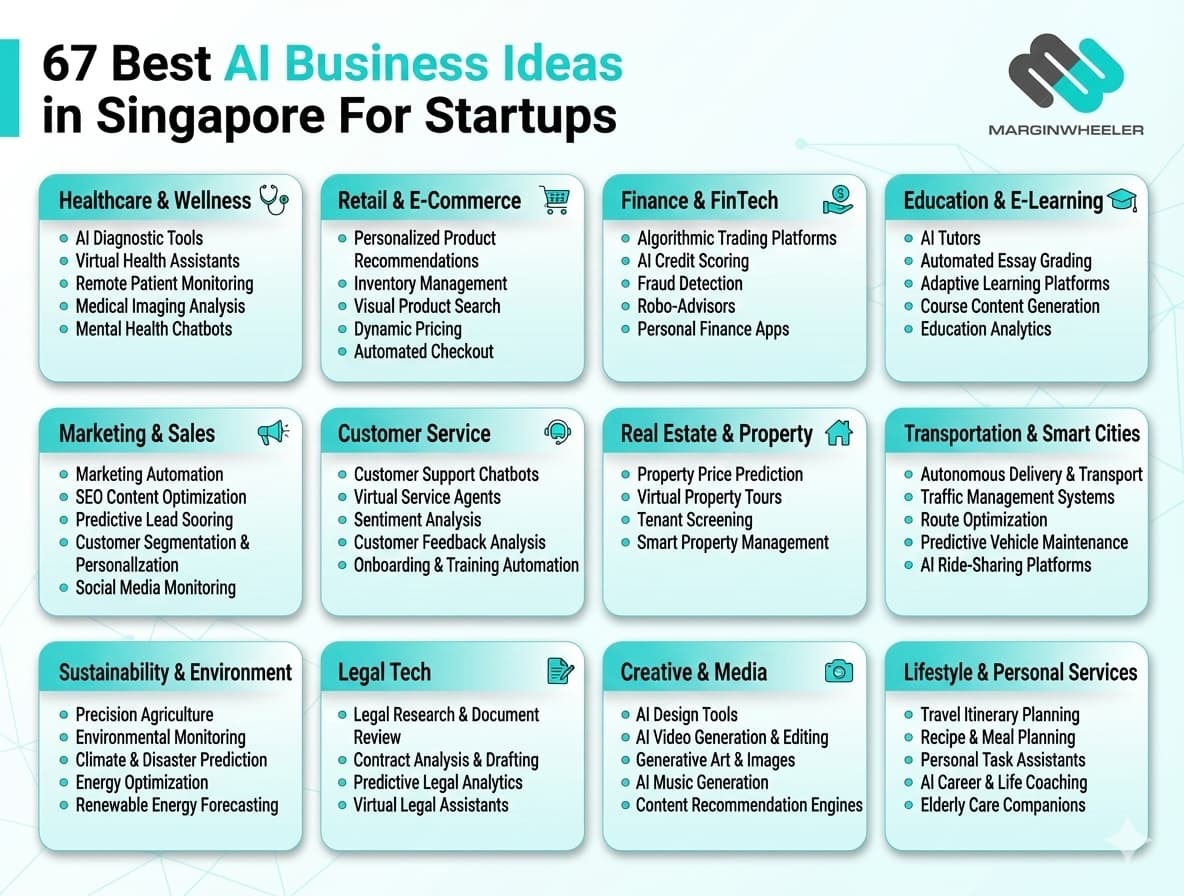
Healthcare & Wellness AI Solutions
1. AI-Powered Diagnostic Tools
Develop AI systems that help doctors detect diseases early by analyzing patient symptoms or medical scans. These tools don't replace physicians but act as intelligent assistants, catching things that might be missed during busy clinic hours. With Singapore's aging population, diagnostic support tools are increasingly valuable.
2. Virtual Health Assistants
Create AI chatbots that handle the heavy lifting of patient inquiries, appointment scheduling, and basic triage. These virtual assistants work 24/7, answering common questions like "What are your operating hours?" or "Do I need to see a specialist for this symptom?" This frees up clinic staff to focus on actual patient care.
3. Remote Patient Monitoring
Build an AI-driven telemedicine platform that tracks patient vitals and recovery data in real time. The system can alert doctors when something looks concerning and help personalize treatment plans based on how patients are responding. This is especially useful for chronic disease management and post-surgery care.
4. AI Medical Imaging Analysis
Develop tools that interpret X-rays, MRIs, and CT scans to spot abnormalities faster and more accurately. Radiologists are in high demand and often overworked. An AI assistant that can flag potential tumors or fractures for human review can significantly speed up diagnosis times.
5. Mental Health Chatbots
Provide AI-based mental health support through apps that engage users in conversation, offer coping strategies, and recognize when professional help is needed. These "digital therapists" make basic mental health support more accessible, especially for people who might feel uncomfortable seeking traditional counseling right away.
Retail & E-Commerce Innovations
6. Personalized Product Recommendations
Use AI to analyze customer behavior and recommend products tailored to individual tastes. This could be a plugin for Shopify or WooCommerce stores that significantly boosts conversion rates by showing customers exactly what they're likely to buy.
7. Inventory Management Optimization
Develop an AI system that prevents the nightmare scenarios of overstock (tying up capital) or stockouts (losing sales). By forecasting demand based on trends, seasonality, and other factors, retailers can optimize stock levels and reduce waste.
8. Visual Search for Shopping
Let customers upload a photo of something they like and find similar products in your catalog. Spotted a great outfit on Instagram? Snap a pic and find something similar. This makes shopping more interactive and taps into how people naturally discover products.
9. Dynamic Pricing Algorithms
Create a pricing platform that adjusts product prices in real-time based on demand, competition, inventory levels, and market trends. Airlines and hotels have done this for years. Now e-commerce stores can maximize profitability by responding intelligently to market conditions.
10. Automated Checkout Systems
Offer smart retail solutions using computer vision where customers walk out with goods and get charged automatically. Think Amazon Go but for Singapore retailers. This eliminates checkout lines and reduces labor costs while improving the shopping experience.
Finance & FinTech Opportunities
11. Algorithmic Trading Platform
Build an AI-powered trading system that executes trades automatically based on data-driven strategies. The AI analyzes market signals and executes in split seconds, which can be especially valuable in volatile crypto or forex markets.
12. AI Credit Scoring
Develop smarter credit scoring models that assess loan applicants more accurately by analyzing transaction history, payment patterns, and other alternative data. This can help responsible borrowers who might not have traditional credit histories while reducing default risk for lenders.
13. Fraud Detection and Prevention
Offer a fintech service that monitors transactions and flags suspicious activities in real time. With online payment fraud constantly evolving, AI that can spot unusual patterns (like a card being used in Singapore and London within an hour) is invaluable for banks and e-commerce platforms.
14. Automated Investment Advisors (Robo-Advisors)
Create a robo-advisor platform that provides automated financial advice and portfolio management. Using AI, it tailors investment strategies to each person's goals, risk tolerance, and timeline, making wealth management accessible beyond just high-net-worth individuals.
15. Personal Finance Management App
Launch an AI app that analyzes spending patterns and income to provide budgeting advice and savings tips. It acts as a virtual financial coach, helping people understand where their money goes and how to optimize their expenses.
Education & E-Learning AI Solutions
16. Intelligent Tutoring Systems
Build an AI tutor that offers personalized learning experiences. The system adapts to each student's pace and style, providing extra help on challenging topics and accelerating through areas they grasp quickly. This is particularly valuable for students preparing for important exams.
17. Automated Essay Grading
Develop tools that use AI to grade essays and free-form answers quickly and consistently. This saves teachers enormous amounts of time on routine grading and gives students instant feedback, which is crucial for learning.
18. Adaptive Learning Platforms
Create e-learning platforms that adjust content difficulty based on learner performance. The AI recommends specific lessons or exercises for improvement, making learning more efficient. This works for everything from language learning to professional certifications.
19. AI Content Creation for Courses
Help educators create learning materials using generative AI: practice questions, summaries, lecture notes, and more. This lowers the content development burden and helps keep materials current without requiring educators to start from scratch every time.
20. Educational Analytics & Insights
Offer data analytics for schools that uses AI to analyze student performance and identify trends. It could predict which students might need extra help or which teaching methods are most effective, enabling schools to make data-driven decisions.
Marketing & Sales AI Solutions
21. AI Marketing Automation
Provide platforms that automate marketing campaigns: segmenting audiences, sending optimized emails at the best times, and adjusting ad spend based on performance. This helps brands save time while improving campaign effectiveness through continuous optimization.
22. SEO Content Optimization
Use AI to analyze website content and suggest improvements for better search engine rankings. The AI might recommend keywords, edit meta tags, or rewrite content to be more search-friendly, driving more organic traffic without expensive ads.
23. Predictive Lead Scoring
Create sales tools that predict which leads are most likely to convert. By analyzing past customer data and behaviors, it ranks incoming leads so sales teams can focus their energy on the most promising opportunities rather than chasing cold leads.
24. Customer Segmentation & Personalization
Develop AI services that cluster customers into segments based on behavior and demographics, then personalize marketing for each segment. This powers more targeted advertising and product recommendations, dramatically increasing engagement and conversion rates.
25. Social Media Monitoring & Management
Offer AI-driven tools that track brand mentions and customer sentiment across platforms. It can suggest optimal posting times, generate content ideas, and even alert you to potential PR issues before they blow up.
Customer Service & Support
26. AI Chatbots for Support
Deploy chatbots that handle customer inquiries on websites and messaging apps. They provide instant answers to FAQs, guide users through common issues, and escalate complex queries to human agents. This dramatically improves response times while reducing support workload.
27. Virtual Customer Service Agents
Create advanced virtual agents that interact via voice or text in human-like ways. They can handle order tracking, basic troubleshooting, and account inquiries, providing 24/7 automated support that never takes a coffee break.
28. Sentiment Analysis Tools
Develop AI that monitors customer communications to gauge sentiment and emotion. Businesses can identify unhappy customers in real time and intervene before a bad experience turns into a scathing online review.
29. Customer Feedback Analyzer
Provide services that use AI to analyze customer feedback from surveys, reviews, and support tickets. It summarizes large volumes of feedback and highlights actionable insights, helping companies understand what's working and what needs improvement.
30. Predictive Customer Support
Introduce systems that predict customer issues before they arise. For example, if usage data shows a customer is likely to experience a problem, support can proactively reach out with a solution, turning potential frustration into delight.
HR & Recruitment AI Tools
31. AI Resume Screening
Build HR tools that automatically review and rank resumes for job openings. The AI highlights top candidates based on skills and experience, speeding up screening and reducing unconscious bias by focusing purely on qualifications.
32. Intelligent Candidate Matching
Develop platforms that use AI to match candidates with the best-fit roles. By analyzing both hard skills and soft skills, it can recommend ideal pairings that recruiters might overlook, improving quality of hire and reducing turnover.
33. Interview Scheduling Assistant
Offer AI assistants that coordinate interview schedules between candidates and interviewers. They handle timezone differences, send calendar invites, and manage reminders automatically, saving recruitment teams countless hours of back-and-forth emails.
34. Employee Engagement Analytics
Create solutions that monitor and analyze employee engagement through survey results, communication patterns, and productivity metrics. HR can identify teams at risk of low morale or high turnover and take preventive action.
If you're setting up an HR tech company in Singapore, you'll need to incorporate your business properly to ensure compliance with local employment laws and data protection regulations.
35. Onboarding & Training Automation
Provide AI-powered onboarding platforms that guide new hires through orientation and training. They personalize the experience, answer common questions via chatbot, and ensure each employee completes required tasks, making onboarding smoother and more consistent.
Real Estate & Property Tech
36. Property Price Prediction
Develop AI models that estimate property values and rental prices with high accuracy. Real estate agencies, investors, and consumers can use this to inform pricing decisions and identify good deals in Singapore's competitive property market.
37. Virtual Property Tours
Create services that generate AI-powered virtual tours or staging for properties. Using 3D imaging, potential buyers or renters can explore properties remotely in immersive ways, saving everyone time on physical viewings.
38. Tenant Screening with AI
Offer platforms that vet rental applicants quickly by analyzing credit history, employment records, and other relevant data. This provides landlords with risk scores for each applicant, streamlining tenant selection while maintaining fairness.
39. Smart Property Management
Build AI-driven property management systems that automate maintenance requests, detect utility usage anomalies, and predict building maintenance needs. The AI could analyze sensor data to predict equipment failures or optimize energy use, reducing costs and downtime.
Transportation & Smart Cities AI Innovations
40. Autonomous Vehicles and Delivery
Focus on specific niches in self-driving technology, like autonomous delivery robots for campuses and neighborhoods or self-driving shuttles for last-mile transport. Developing or integrating AI for safe navigation taps into the growing demand for contactless delivery and smart mobility solutions.
41. AI Traffic Management
Create smart city solutions that use AI to optimize traffic light control and traffic flow. By analyzing real-time traffic data, such systems can reduce congestion and commute times in busy urban areas, which is highly relevant for Singapore's dense environment.
42. Route Optimization Service
Offer logistics tools that leverage AI to find the most efficient delivery or transportation routes. This benefits delivery companies, ride-hailing services, and logistics providers by reducing fuel costs and improving on-time performance while accounting for real-time traffic, weather, and other variables.
43. Predictive Vehicle Maintenance
Develop AI systems for fleet operators that predict when vehicles need maintenance before breakdowns occur. Using sensor data from trucks, buses, or taxis, the AI flags wear-and-tear issues in advance, helping companies avoid costly downtime and ensure safety.
44. AI-Enhanced Ride-Sharing
Launch a next-generation ride-sharing or carpooling platform that uses AI to dynamically match riders with drivers and optimize shared routes. The AI could also personalize driver-rider matching for comfort or safety preferences and suggest hot zones for drivers based on predictive demand patterns.
Sustainability: Energy, Environment & Agriculture
45. Precision Agriculture
Use AI and IoT sensors to help farmers optimize crop yields and farming inputs. An AI platform could analyze soil data, weather patterns, and crop health (even detecting diseases early via drone imagery) to recommend the right amounts of water, fertilizer, or pest control, boosting output while lowering costs and environmental impact.
46. Environmental Monitoring & Conservation
Develop AI systems to monitor environmental factors like air and water quality or wildlife populations. AI-powered camera traps could track endangered wildlife and detect poaching activity, or smart sensors could identify pollution anomalies in water supplies. Governments and NGOs could use such tools for conservation and public health initiatives.
47. Climate and Disaster Prediction
Create AI models that analyze climate data to predict natural disasters or climate trends. This could include forecasting flash floods, forest fire risks, or long-term climate shifts. Such insights are valuable for urban planning and insurance companies, helping communities prepare and adapt proactively.
48. Energy Consumption Optimization
Offer AI-based energy management systems for buildings or factories that reduce electricity usage and costs. The AI learns patterns in energy usage and automatically adjusts HVAC, lighting, or machinery settings for efficiency. In a smart city like Singapore, this aligns perfectly with green initiatives to cut wastage.
49. Renewable Energy Forecasting
Provide services for power grid operators that use AI to predict renewable energy output from solar and wind sources and manage load balancing. By forecasting how much solar power a city's panels will generate tomorrow, the system helps schedule backup power from other sources, ensuring a stable and efficient grid.
Cybersecurity AI Solutions
50. AI Threat Detection
Develop cybersecurity software that employs AI to detect malware and cyber threats in real-time. By learning patterns of normal versus malicious behavior, the AI can catch emerging threats like new viruses or network intrusions much faster than traditional methods.
51. Intelligent Security Monitoring
Create AI-driven security operations center tools that continuously monitor network activity and automatically respond to incidents. If an AI spots an unusual data transfer indicative of a breach, it could immediately isolate that server or alert security personnel, speeding up incident response.
52. User Behavior Analytics
Offer solutions that track and analyze user behavior within corporate systems to flag anomalies. If an employee's account suddenly downloads a huge volume of data at 3 AM (unusual for them), the AI can suspend the activity and alert the security team to a potential insider threat or compromised account.
53. Identity Verification and Fraud Prevention
Implement AI-based biometric and identity verification tools for online services. This could include facial recognition or voice recognition systems that are harder to fool, enhancing security for banking, e-commerce, or government services. The AI can also verify documents and detect deepfake identities, helping businesses reduce fraud.
Legal Services
54. AI Legal Research & Document Review
Develop legal tech tools that use AI to sift through vast legal databases and documents quickly. This helps lawyers or in-house legal teams find relevant case law or precedents in seconds, or review lengthy contracts and flag key points or anomalies (a process known as e-discovery).
55. Contract Analysis and Drafting
Provide AI platforms that analyze contracts for risks, missing clauses, or compliance issues. They could also suggest edits or generate first drafts of standard contracts. Businesses save time by having AI review legal documents and catch issues like unfavorable terms before a human signs off.
56. Predictive Legal Analytics
Create solutions that predict legal outcomes or case durations using AI trained on historical case data. Law firms or litigation funders could use it to assess the likely success of a case or potential settlement amounts. An AI might estimate the chance of winning a lawsuit based on past judgments, informing legal strategy.
57. Virtual Legal Assistant
Build chatbots or voice assistants specialized in legal guidance for simple matters. This AI could answer common legal questions about landlord-tenant rights, employment law basics, or help lawyers with administrative tasks like scheduling and time tracking. While it wouldn't give official advice, it makes legal information more accessible.
Creative, Media & Entertainment
58. AI Design Assistants
Offer AI tools that assist with graphic design, web design, or UI/UX design tasks. An AI could generate layout suggestions, create logo variations, or automatically adjust graphic elements according to design principles. This helps designers (or non-designers) produce quality designs faster.
59. AI Video Generation & Editing
Create services that use AI to generate or edit videos. This could range from turning blog posts into short video summaries to an AI video editor that automatically cuts raw footage into polished clips, selecting scenes, adding transitions and subtitles. Businesses and content creators could produce videos quickly without advanced skills.
60. Generative Art and Image Creation
Leverage AI models to produce original art, illustrations, or stock images on demand. A startup could offer custom AI-generated artwork for clients (marketing agencies, game developers) or provide a platform where users describe what they need and the AI creates it. This opens up creative possibilities in advertising, design, and entertainment.
61. AI Music Composition
Develop AI-based music generators that create music or soundscapes for various needs like background music for videos, games, or relaxation. Users could input a desired mood or genre, and the AI composes an original track. This saves time and licensing costs for content creators who need custom music.
62. Personalized Content Recommendation
Build AI recommendation engines that media companies can use to keep users engaged. A streaming service can use such AI to suggest movies or songs tailored to each user's taste based on their viewing or listening history, increasing user satisfaction and time spent on the platform. This extends to news apps, online forums, or any platform with abundant content.
Lifestyle & Personal Services
63. AI Travel Itinerary Planner
Turn trip planning into a breeze by offering an AI that creates personalized travel itineraries. Users input their destination, interests, budget, and timeline, and the AI planner suggests a day-by-day schedule of activities, restaurants, and sites to visit, even adjusting on the fly for weather or changes. This can be offered as a consumer app or a service via travel agencies.
64. Recipe Generator and Meal Planning
Develop an AI cooking assistant that suggests recipes based on the ingredients you have and your dietary preferences. A user can input the contents of their fridge and get creative meal ideas. The AI could also plan weekly meals, generate shopping lists, and adjust recipes for portion size or nutritional goals.
65. AI Personal Assistant for Daily Tasks
Create a virtual personal assistant service where an AI helps individuals manage to-do lists, calendars, and daily tasks. Busy professionals or the elderly could delegate tasks like scheduling appointments, paying bills, or even drafting emails to the AI. By combining natural language processing with integration into apps, this "AI concierge" saves users time and keeps them organized.
66. AI Career or Life Coach
Offer a coaching platform powered by AI that helps people with career development and personal goals. The AI coach could help users improve their resumes, practice for interviews by asking common questions and assessing answers, suggest skill development paths, or provide motivation and productivity tips. Over time, it learns the user's communication style and aspirations to give tailored advice.
67. Elderly Care Companion
Innovate an AI-driven companion for seniors living alone or in care facilities. This could be a smart speaker or robot that converses with the elderly, reminds them to take medication, monitors their well-being (alerting caregivers if something seems wrong), and provides companionship. In an aging society, such AI companions can improve quality of life for seniors and ease the load on human caregivers.
Choosing the Right AI Business Idea
With so many ideas on the table, how do you choose? Here are some practical questions to guide your decision:
What problem are you passionate about solving? The AI startups that succeed are usually led by founders who deeply understand the problem they're tackling. If you've worked in healthcare and seen firsthand how scheduling chaos affects patient care, a virtual health assistant might be your calling.
Where's your expertise? You don't need to be an AI expert (you can hire that), but domain knowledge is gold. A former teacher will build a better adaptive learning platform than someone who's never set foot in a classroom.
What's the market size? Some AI applications serve niche markets, others have massive potential. Both can be profitable, but they require different strategies and funding approaches.
Can you start small and iterate? The best AI businesses often start by solving one specific problem really well, then expand. Don't try to build everything at once.
What's your capital situation? Many of these ideas can start lean (like chatbots or analytics services), while others (like autonomous delivery systems) require significant upfront investment. Be realistic about what you can bootstrap versus what needs funding.
Getting Your AI Startup Off the Ground
Starting an AI business in Singapore comes with some practical considerations. Beyond the brilliant idea, you'll need to handle company registration, accounting, and corporate compliance. That's where professional support becomes valuable.
For founders who need help with accounting services, having experts manage your books means you can focus on building your product rather than wrestling with financial statements. And once your company is up and running, you'll need ongoing corporate secretarial services to stay compliant with ACRA requirements, manage annual filings, and handle corporate governance matters.
The AI Advantage in Singapore
Singapore's ecosystem offers unique advantages for AI startups. The government actively supports AI development through grants and programs. The city-state's excellent digital infrastructure means you're not fighting basic connectivity issues. And being a regional business hub puts you close to potential clients across Southeast Asia.
The regulatory environment is also relatively straightforward compared to many countries, especially if you work with professional service providers who understand local requirements. Whether you're developing healthcare AI (which needs careful compliance consideration) or marketing tools (which are more straightforward), Singapore's frameworks are designed to support innovation while maintaining necessary safeguards.
Final Thoughts
The AI revolution isn't coming. It's already here. The question isn't whether AI will transform industries, but who will build the tools that make it happen. Singapore is positioning itself as a key player in this transformation, and the opportunities for founders are genuinely exciting.
The beauty of AI businesses is that you're not just chasing profits. You're solving real problems: helping doctors save lives, making education more accessible, reducing waste in supply chains, or giving small businesses tools that were once available only to enterprises. That's meaningful work.
So pick an idea that resonates with you, validate it with potential customers, and start building. The infrastructure is here, the market is ready, and the timing couldn't be better. Singapore's AI future is being written right now. Will you be part of the story?