







Updated: 15 Jul 2026
One of the earliest decisions a Singaporean business should make when expanding into Malaysia is whether key team members will be relocating across the Causeway to support the venture.
If yes, said team member(s) will likely need a Malaysian work visa.

For skilled roles the two main visas are Employment Passes (EP) and Professional Visit Passes (PVP), and in short:
-
EP if the team member will be directly employed by the Malaysian entity
-
PVP if the team member remains employed and paid by the Singapore company during a short-term assignment in Malaysia
As we explain below, both can easily take up to eight months, so the sooner you decide, the faster you can kickstart the process.
If that's all you needed, we wish you all the best with your Malaysian expansion, but for a more complete understanding, read on as we cover:
-
ESD vs XPATNOVA (+Xpats Gateway)
-
requirements the Malaysian entity must meet
-
requirements for expatriates
-
choosing the correct EP category
-
application process and timelines, and
-
common reasons for returns and rejections
Let’s begin.
ESD vs XPATNOVA
As Johor is a popular spot for Singapore companies, but not every Singapore company will expand to Johor, we’ll start with this.
Both the Expatriate Services Division (ESD) and XPATNOVA review and approve / reject work visa applications, but which one reviews yours depends on where your Malaysian business is based.
XPATNOVA only manages employers based in Johor's Iskandar region.
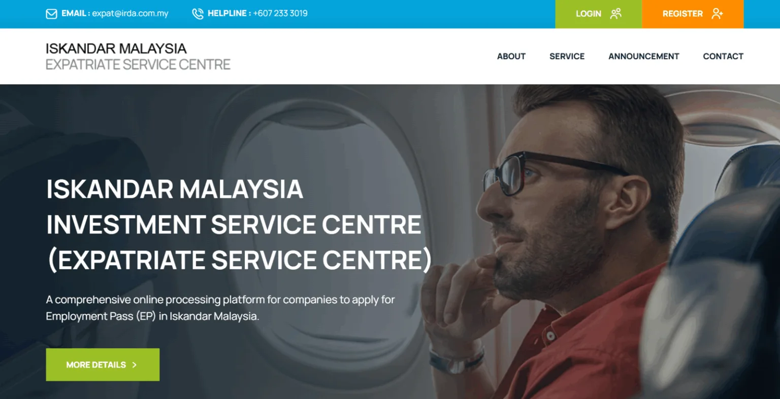
Meanwhile, ESD manages employers in the rest of Peninsular Malaysia.

Across both, the actual application steps, fees, and requirements are similar, including how they incorporate the Xpats Gateway system.
Xpats Gateway
ESD and XPATNOVA decide on application approval / rejection, but submission is done via a separate platform called Xpats Gateway which connects employers with regulatory agencies to obtain supporting documents.
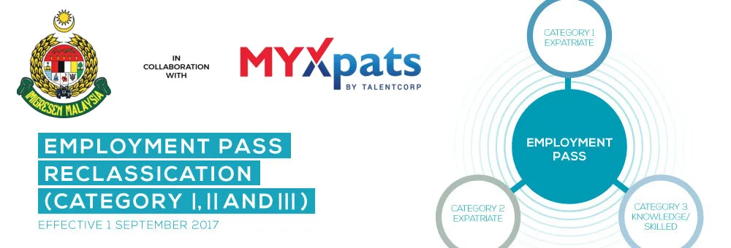
Naturally, Xpats Gateway is linked to both ESD and XPATNOVA, so once you submit an application through the former, progress can be tracked via the latter platforms.
With that, let’s cover requirements to apply for an expat work visa.
Employer eligibility requirements

Be it under ESD or XPATNOVA, Malaysian work visas are applied for by the Malaysian entity, not the foreign parent, and so the Singapore business must already have a registered business entity in Malaysia.
If the entity is a local private limited company (Sdn Bhd), it must also meet minimum paid-up capital requirements based on foreign ownership:
-
Joint venture with at least 30% foreign ownership: RM350,000
-
100% foreign-owned: RM500,000
Companies with 51% or more foreign equity will also most likely need a Wholesale, Retail & Trade (WRT) or Unregulated Services Sector (USS) licence.
Both these licenses require a minimum paid-up capital of RM1 million.
Finally, Immigration will assess the company's operational presence and financial capacity to ensure it can genuinely support the expatriate position and salary being applied for.
Skilled foreign talent & role requirements

Like all expats, foreigners are generally assessed based on three areas:
-
academic qualifications
-
professional experience
-
immigration history
Beyond the employee's credentials, Immigration also considers if the position itself justifies hiring a foreign national.
Academic qualifications and experience
The employee should satisfy one of the following qualification thresholds:
-
Degree holder with at least 3 years of relevant professional experience
-
Diploma holder with at least 5 years of relevant experience
-
Technical or professional certificate holder with at least 7 years of practical experience
Qualifications should be directly relevant to the proposed role and submitted as Certified True Copies (CTC) where required.
Immigration history
Applicants should have a satisfactory Malaysian immigration record.
Previous overstays, blacklisting, or improperly cancelled work passes may affect approval and should be resolved before submission wherever possible.
Role requirements
Whether applying for an EP or PVP (but especially EP), the role should require knowledge, skills, or experience that justifies employing a foreign national over Malaysian talent.
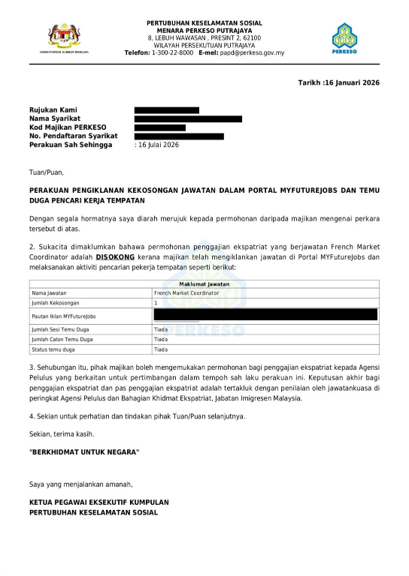
For EP roles with monthly salaries below RM15,000, employers must also demonstrate efforts to recruit locally by advertising on MyFutureJobs for at least 14 days and interviewing locals.
Choosing the right EP category
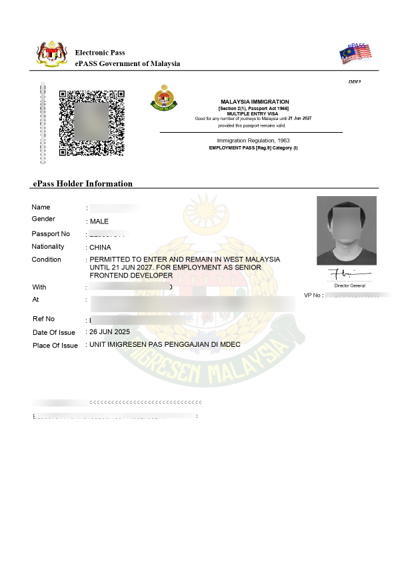
Unlike one-size-fits-all PVPs, EPs are offered into three categories based on pay and seniority.
Choosing the right category is essential, as Immigration expects clear alignment between the employee's role, salary, qualifications, and category being applied for.
|
Category |
Use sase |
Typical roles |
Min salary |
Max validity |
|
1 |
Senior leaders and decision makers |
CEO, Managing Director, Country Manager |
RM20,000 / month |
10 years |
|
2 |
Mid-level management and specialists |
Department Manager, Finance Manager, Engineer, Software Developer, Consultant, Regional Specialist |
RM10,000 / month |
10 years |
|
3 |
Junior professional and technical positions |
Analyst, Junior Engineer, Sales Executive |
RM5,000 / month (RM7,000 in manufacturing roles) |
5 years |
Additional notes
-
all EP categories allow dependents, subject to standard Immigration requirements
-
Category 2 and 3 applications are expected to include a succession plan explaining how the company will train a Malaysian employee to eventually assume the role
-
Category 1 applications are generally more straightforward as senior leadership positions naturally justify higher salaries and expatriate appointments
-
Immigration evaluates EP applications holistically, looking for consistency between the employee's qualifications, seniority, proposed role, salary, and selected EP category
-
any attempt to ‘game’ the system like appointing a highly experienced executive under Category 3 with a RM5,000 salary is very likely to be flagged and rejected
Application process & timeline
A company's first EP or PVP typically takes six to eight months based on document readiness, sector approvals, and Immigration backlog.
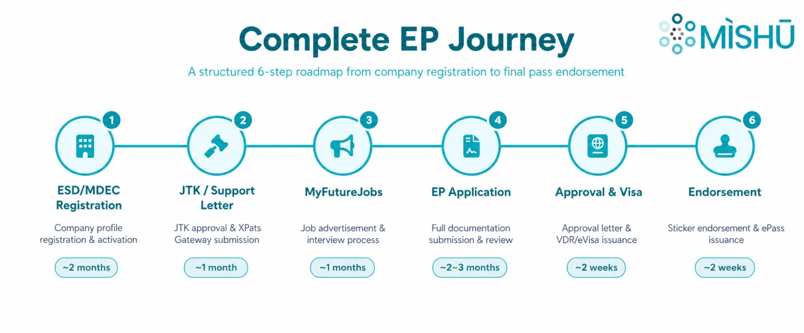
This consists of five to six main stages depending on type of visa.
|
Stage |
Description |
Estimated timeline |
|
1. ESD / XPATNOVA registration |
Company registration and activation on the ESD / XPATNOVA portal |
~2 months |
|
2. JTK / XPats Gateway approval |
Workforce approval and support letter (where applicable) |
~1 month |
|
3. MyFutureJobs compliance (if required) |
Local recruitment advertisement and interview process |
~1 month |
|
4. EP / PVP application submission |
Immigration assessment and processing |
~2–3 months |
|
5. Approval & visa issuance |
Approval letter together with VDR or eVisa issuance |
~2 weeks |
|
6. Endorsement & ePass |
Entry into Malaysia and final endorsement |
~2 weeks |
Companies only need to register their ESD / XPATNOVA account once, so future visa applications begin after the ESD registration stage.
Also, roles earning >RM15,000 are typically exempt from MyFutureJobs advertising, so Category 1 and some Category 2 applications enjoy faster processing by skipping a step.
Finally, visa renewals are significantly faster than first-time applications and can often be completed within one to two months.
Application fees
The entire process can be self-managed and registrations for ESD and XPATNOVA are free so main costs will be Immigration fees.
That said, if you don’t like dealing with Singaporean government agencies, you definitely won’t have fun with their Malaysian counterparts 🙂
To help readers budget, we’ve summarised estimates of self-handled application versus different levels of outsourcing to MISHU:
|
Pass Type |
Self-managed |
Outsourced application (Stage 4 - 6) |
Outsourced end-to-end (Stage 1 - 6) |
|
PVP |
RM1,400 – RM1,700 / application |
+ RM3,500 / application |
+ RM7,000 - RM9,000 for full application support |
|
EP |
~RM2,500 / application (for 1-year endorsement) |
+ RM4,000 / application
|
While the self-managed costs are fixed to immigration fees, third party charges obviously differ between providers, so feel free to use ours as a benchmark.
Now for our last section - and one of the main reasons agencies like us will likely stick around - avoiding common reasons for work visa rejections!
Avoiding common reasons for rejections
Disclaimer: We’re assuming the application satisfies Immigration rules - no amount of tweaking is likely to make a difference otherwise!
That said, even eligible applications can be returned or rejected.
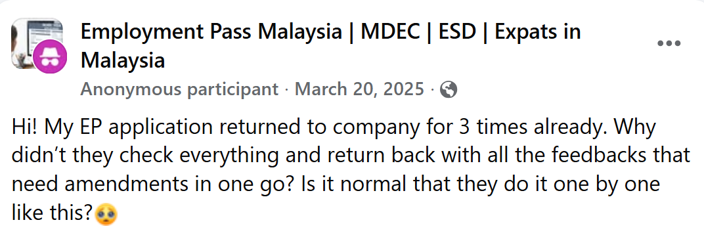
Here’s how to avoid that from happening.
Returned applications
A returned application is usually caused by technical, documentation, or submission issues such as
-
passport photos that do not meet Immigration specifications
-
names or personal details that do not match passport information
-
missing company stamps, signatures, or required endorsements
-
incomplete supporting documents or agreements
-
poor-quality scans or incorrect file formats
-
missing Certified True Copy (CTC) documents where required
-
gaps or inconsistencies in the candidate’s CV or employment history
Rejected applications
A rejected application usually indicates doubt about the suitability of the candidate, role, or employer, and common reasons include:
-
candidate’s stated experience does not sufficiently match the role
-
role does not appear specialised or suitable for foreign talent
-
employer’s financial profile does not support the application
-
job scope, title, salary, and candidate background are not aligned
-
role does not demonstrate a clear need for a foreign employee
Again, assuming the application genuinely satisfies Immigration guidelines, carefully review the entire application beforehand and a visa agency sure does come in handy.
This obviously applies to any of the highly capable visa service providers in Malaysia, but we’d obviously prefer you to choose MISHU!
That's it from us, and we wish you all the best with your expansion 🙂